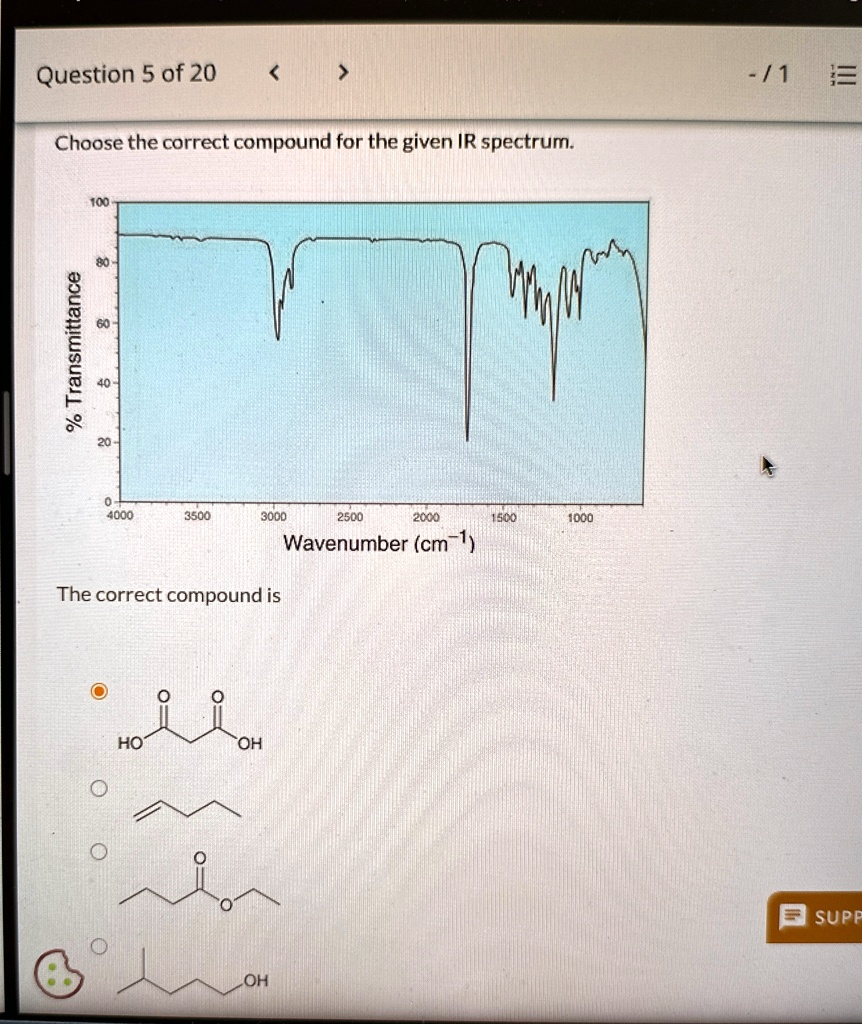
Choose the correct compound for the given IR spectrum. % Transmittance 100 80 60 40 20 0 4000 3500 3000 2500 2000 The correct compound is HO OH OH 1500 1000 Wavenumber (cm
) SUPP -/1
The Correct Answer and Explanation is:
Analysis of the IR Spectrum:
- Broad O-H Stretch (Carboxylic Acid): The most prominent feature is the extremely broad and strong absorption that spans from approximately 3300 cm⁻¹ down to 2500 cm⁻¹. This characteristic “hairy beard” shape, which overlaps with the C-H stretching region, is the definitive signature of the O-H stretching vibration in a hydrogen-bonded carboxylic acid. The extensive hydrogen bonding in carboxylic acid dimers causes this significant peak broadening.
- C(sp³)-H Stretch: There are sharp peaks just below 3000 cm⁻¹ (around 2950-2850 cm⁻¹). These absorptions are due to the stretching vibrations of C-H bonds where the carbon atom is sp³-hybridized (i.e., saturated carbons).
- C=O (Carbonyl) Stretch: A very strong and sharp absorption peak is observed at approximately 1710 cm⁻¹. This is characteristic of a C=O carbonyl stretch. Its position is consistent with that of a saturated carboxylic acid, which typically absorbs in the 1700-1725 cm⁻¹ range.
- Fingerprint Region: There are additional peaks below 1500 cm⁻¹, including a C-O stretch (around 1300-1200 cm⁻¹) and a broad O-H bend (around 920 cm⁻¹), which further support the presence of a carboxylic acid.
Evaluation of the Options:
- First compound (A dicarboxylic acid, likely malonic or succinic acid): This molecule contains two carboxylic acid (-COOH) functional groups and saturated C(sp³)-H bonds. This structure is perfectly consistent with all the major peaks identified in the spectrum: the very broad O-H stretch, the strong C=O stretch at ~1710 cm⁻¹, and the C(sp³)-H stretches.
- Second compound (An alkene): This molecule contains C=C double bonds and C-H bonds (both sp² and sp³). It lacks both the O-H and C=O functional groups. Its spectrum would show C(sp²)-H stretches above 3000 cm⁻¹ and a C=C stretch around 1650 cm⁻¹, but none of the key features observed.
- Third compound (An ester): This molecule has a C=O group and C(sp³)-H bonds. While it would show a strong C=O peak (typically higher, around 1735-1750 cm⁻¹) and C-H stretches, it completely lacks an O-H group and therefore would not have the very broad absorption from 3300-2500 cm⁻¹.
- Fourth compound (An alcohol): This molecule has an O-H group and C(sp³)-H bonds. It would show a broad O-H stretch (typically centered around 3300 cm⁻¹) and C-H stretches. However, it lacks a C=O group, so the strong peak at 1710 cm⁻¹ would be absent.
Conclusion:
The simultaneous presence of a very broad O-H stretch (3300-2500 cm⁻¹) and a strong C=O stretch (~1710 cm⁻¹) is conclusive evidence for a carboxylic acid functional group. Among the given choices, only the first compound is a carboxylic acid.
The correct compound is:
O        O
      //       //
HO - C - CH₂ - C - OH
content_copydownloadUse code
(This specific structure is malonic acid, a dicarboxylic acid, which fits the spectral data.)