Predict the major product of the reaction sequence. 1.
No Reaction
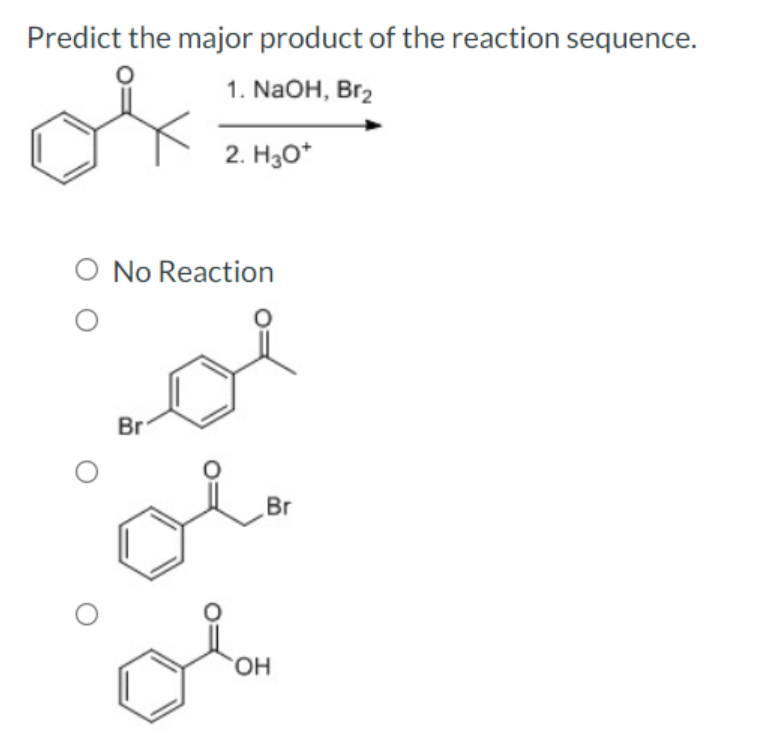
The Correct Answer and Explanation is:
The correct answer is No Reaction.
Here is a detailed explanation of why no reaction occurs:
The reaction conditions given, 1. NaOH, Br₂ and 2. H₃O⁺, are characteristic of the haloform reaction. The haloform reaction is a specific chemical reaction where a haloform (CHX₃, where X is a halogen) is produced by the exhaustive halogenation of a methyl ketone (a ketone with a R-CO-CH₃ structure) in the presence of a base. The reaction also works for secondary alcohols that can be oxidized to methyl ketones under the reaction conditions.
The mechanism of the haloform reaction involves several steps:
- Enolate formation: The base (hydroxide ion, OH⁻) removes an acidic alpha-hydrogen (a hydrogen on the carbon adjacent to the carbonyl group) to form an enolate ion.
- Alpha-halogenation: The enolate then attacks the halogen (Br₂), adding a bromine atom to the alpha-carbon.
- Cleavage: This process repeats until all three alpha-hydrogens of the methyl group are replaced by bromine atoms. The resulting trihalomethyl ketone is then attacked by hydroxide at the carbonyl carbon. This leads to the cleavage of the C-C bond, releasing a carboxylate anion and a tribromomethanide anion (CBr₃⁻).
- Protonation: The CBr₃⁻ anion is a strong enough base to deprotonate the carboxylic acid formed in the previous step. The final acidic workup (H₃O⁺) protonates the carboxylate salt to yield the final carboxylic acid product.
Let’s examine the starting material: 2,2-dimethyl-1-phenylpropan-1-one. The carbonyl group is attached to a phenyl group on one side and a tert-butyl group on the other. For the haloform reaction to occur, there must be at least one hydrogen atom on the alpha-carbon.
In this molecule, the carbon atom alpha to the carbonyl group within the alkyl (tert-butyl) chain is a quaternary carbon. This means it is bonded to four other carbon atoms and has no alpha-hydrogens. Because there are no acidic alpha-hydrogens, the hydroxide base cannot deprotonate the molecule to form an enolate. Since the formation of an enolate is the essential first step of the haloform reaction, the reaction cannot proceed.
Other possible reactions, like electrophilic aromatic substitution on the phenyl ring, are not favored under these basic conditions and without a proper catalyst. Therefore, the starting material does not react, and it is recovered unchanged after the workup.